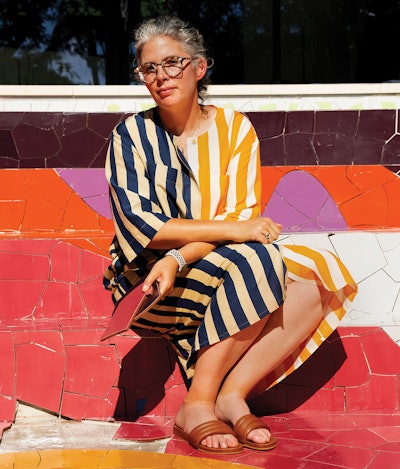
It’s no secret that pools are an art piece by their own merit — the ability to create lavish backyard spectacles cannot go unnoticed. But when traditional art and pools collide, you see something magnificent come to life. This is exactly what Alex Proba, founder of Studio Proba, has managed.
Proba’s art can be found virtually anywhere. Studio Proba creates in all aspects of the word, from product and branding design to illustration, sculpture and interior design. Recently, however, Proba has entered new territory: pools.
Her latest project includes the Fernandez Pool, a sweeping masterclass in tilework and vibrant color, bringing the swimming pool to life in ways rarely seen before. In addition to the Fernandez Pool, Proba painted two other pools to spark new life into them.
AQUA had the privilege of speaking to the Portland and Brooklyn-based artist about her creative process, her adventures in pool painting and where she hopes this new avenue will take her.
 Photo courtesy Studio Proba
AQUA: How did you end up making pools your latest canvas?
Alex Proba: Oh, it was actually my idea. They’ve been on my bucket list of projects I want to do, and I think maybe starting in 2016 or 2017, I did renderings of realistic architectural spaces with pools and added my art to it and was posting that online to see if there was any client around that wanted it.
Yeah, I just needed it for myself to make it happen. I believe that pools are just forgotten canvases, and I think often, you just make them blue or white, but the water makes it blue. And so, I think that was self-calling. And then, yeah, in 2019 or 2020, my first pool client reached out. That’s kind of how it happened.
 Photo courtesy Studio Proba
AQ: What kinds of pools draw you in when looking for a new space to craft a mural?
AP: I want to clarify — I don’t paint newly built pools or public spaces for many reasons. Public spaces have a whole different set of rules, a compliance with color and stuff as well. I’ve done the tile options like the Fernandez Pool because you can make those easily public space-approved, but if someone is building a new pool, a new house, I don’t want to just go in and paint it. There’s better materials on the market. If it’s an old-school pool, you’re going to have to paint it anyway. In that case, there’s no harm in painting it different colors.
 Photo courtesy Studio Proba
AQ: What are some of the biggest factors to consider when you add a mural to a pool?
AP: Similar to typical pools that you paint in white or another color…
in time, it fades. It doesn’t deteriorate in a way that it flakes or chips off, but the color fades. And usually, you don’t see that with one- color backgrounds, but if you have an art piece there, you’ll see more changes happening. Fading isn’t a bad thing. Anything that you paint will do that, because of the sun exposure and all that stuff.
It really depends on the client and how bright they want to keep it. If they want to keep it super bright, they just have to repaint it every four years, or more often than a normal timeline would call for.
As for the tile, like in the Fernandez Pool, every tile is handmade and in a different kind of shape. It’s a giant puzzle, so you have to think about timelines and costs. It takes two
to three months to just install, and each piece is different. It’s a massive undertaking.
 Photo courtesy Studio Proba
AQ: You have multiple years of experience as an artist outside of your recent work in pools. Where do you get your inspiration from?
AP: I was always painting. Even as a kid, I painted a lot and had exhibited in little stores in my hometown when I was 13 or 14. And they always had to do with plants and flowers. That came mostly from my upbringing.
My grandma used to be a florist, and she’s the one that raised us. It was kind
of, like, that one colorful space in my life — my grandma and her clothes and her patterns. She still wears patterns on patterns and all that crazy stuff.
At some point, maybe by talking to people and being interviewed, I realized how connected my work still is to my original pieces from being a kid, with realistic florals and the everyday things I used to paint. I turned it into this graphic, abstract language, but everything still stems from the same starting point. It still comes from plants and flowers, but also just nature and the world around us, from rock formations and patterns you see on beaches that form in the sand and things like that.
 Photo courtesy Studio Proba
 Photo courtesy Studio Proba
AQ: What do you hope people take away from your work?
AP: I think the mission, or the thing behind my work that I realized pretty quickly is that I didn’t want to create commentary or some “artist’s commentary” on the world, or whatever it might be. I decided pretty quickly that, “Oh, I want to create something that’s happy and joyful and makes people happy and has no bigger mission than that.”
I just want people to see my work and be able to explore it, climb on it, have a play, just experience it and swim in it versus the darker side of art, which I never wanted to do. I also think my use of colors works for any age. Kids really love my work, but then also older people as well.
 Photo courtesy Madeline Tolle
 Photo courtesy Madeline Tolle
AQ: What does the future look like for you in the pool-painting space?
AP: I would love to do more of this. If I can own it, that would be amazing.
I don’t think that’s going to happen; I think a lot of people might try it themselves, but it won’t be something you’ll suddenly see in every pool, just because of how hard it is to make it happen.
We’re working on different methods to make the process a bit more budget friendly. I’m still getting a lot of requests from customers for quotes and such. It’s not a cheap undertaking, nor is it easy. Especially for tilework. Everything’s handmade, and it’s such a process.
I think that may be shocking to some people when I share a quote for the material and the whole process. It turns people away sometimes.
So I’m curious to see what the future holds, because we’re actively working on different options to keep the high-end result, but have different tiers for pricing, which would make it perhaps more budget friendly.
 Photo courtesy Leigh Webber
 Photo courtesy Madeline Tolle
AQ: You’ve shared in previous interviews over the years that failure is your biggest motivator. Does that still ring true for you?
AP: Yeah, I think a lot of people are just scared of failing. And I think: What’s the point if you don’t fail or you haven’t tried? If you’re scared of failing, it takes away from the joy of figuring something out or making it happen. And each failure brings you further because you learn from it.
I do the same with the pools, when it used to be only renderings that I posted online and was like, “Hey, let’s do this.” I had no clue how to do this right, no idea if it was possible or not. And the paints don’t come in the colors that I have, usually. It’s a whole different thing.
But when the client reached out, I was just like, “Yeah, of course I can do that.” And then I took a couple months to try to figure it out and convince people to make me the colors I want.
But that was another thing — the worst thing that could have happened was that I could have told my clients, “Sorry, not possible in the end.”
That’s kind of how I work in general. I don’t say no to things that seem impossible.
This article first appeared in the October 2025 issue of AQUA Magazine — the top resource for retailers, builders and service pros in the pool and spa industry. Subscriptions to the print magazine are free to all industry professionals. Click here to subscribe.