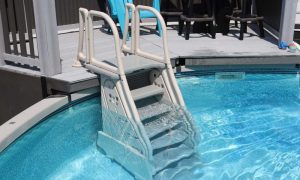
Pool owners are often attracted to a pool that has a colored finish, particularly one with a pebble or quartz plaster finish. The color can add ambiance and make the water look beautiful and inviting. It’s for this reason that pool owners will pay extra money to enhance the water in their pools and to make the whole backyard look more attractive.
It must be frustrating for all parties involved when their colored, pigmented pool becomes unsightly due to whitish streaks, blotches or small spots. It must be equally, if not even more, disappointing to discover that the color issue was misdiagnosed and that the corrective action taken caused further damage.
There are a few preventable causes for the fading or whitishing of plaster colors. Calcium scale is deposited on plaster surfaces when pool water is out of balance. Acid washing is a common remedy for calcium scale, which makes surfaces rough and white.
It is not uncommon for colored plaster surfaces (including pebble and quartz) to lighten due to errors in the plastering process and materials used. These defects can also cause a change in color that is lighter or whitish. It is therefore easy to believe, mistakenly, that the problem was calcium scaling and the water had been out-of-balance. After making a mistaken diagnosis, it’s easy to assume that an acid wash will fix the problem. When there is no scale to be removed, this will only cause etching. This won’t solve the problem, and it will reduce the life expectancy of the plaster.
If the problem is plaster application, the whitened water is most likely a result from soluble calcium ions dissolving in the plaster and escaping into the pool. Calcium dissolution is an indication that the plaster surface has deteriorated, lost density and become porous. It usually stays smooth. When porosity increases and develops (which can be several months), it results in a whitening or pigmented plaster.
Porous surfaces appear lighter because they reflect more light. According to Dr. Boyd Clark of Construction Technology Labs’ senior materials specialist, the same reason a beer head is lighter is because the foam reflects more light.
He says that the increased porosity is what causes a spot or lightened area.
Even common white plaster for pools can develop streaks and spots that are lighter than the surrounding plaster due to increased porosity. The way white and pigmented pool plasters change color is directly related.
Scale vs. Porosity
Calcium scaling is a result of out-of balance water (an excessively positive LSI). It deposits a layer of calcium carbonate on the plaster finish, and it whitens the whole pool. Calcium scale will cover the surface of the pebbles in pebble finishes, as well as the cement that surrounds and binds them together. The calcium scale is usually rough, and can be easily removed by hand using sandpaper.
If, however, the whitish discoloration appears smooth, in streaks, spots or blotches and cannot be removed by diluted acid, or even hand sanding, the problem may not be calcium carbonate scale, but rather a porous, whitening surface.
A very close inspection is required to determine, with pebble finishes if there is a whitish discoloration only in the cement portion that surrounds and binds pebbles. The cement is the only part of the finish that can be porous (a loss in material).
What causes a smooth, but porous surface? Plastering mistakes, as mentioned above, can lead to two relatively soluble ingredients slowly dissolving away, creating an extremely porous surface. These soluble components include calcium hydroxide, a by-product from the cement/water reactions, and calcium chloride if it is added to the mix in order to speed up the hardening.
Many people have the mistaken belief that only aggressive pool water (LSI negative) can dissolve calcium hydroxide or calcium chloride. This isn’t true. Both plaster elements are soluble in positive LSI-water. The whitening and porosity of plaster is not caused by aggressive water.
Other Factors
Other reasons can be found for color loss. Some plasterers and suppliers use organic pigments as part of their plaster mix. Organic pigments are bleached by chlorine, other oxidizers and the sun. Organic pigments may be cheaper than inorganic ones, but are not able to withstand the swimming pool environment.
Some plaster mixes or finishes contain two colors of pigment. One organic pigment will disappear if it is bleached. The other non-bleachable color will remain.
For a detailed explanation of the plastering issues and other aspects, see this link: https://www.poolhelp.com/home/onbalance-research/education/
Remedies
Often, acid treatments are used to restore the original colour of plaster. These acid treatments can etch plaster and cause it to be rough. This leads to the balanced water penetrating a surface that has been etched and dissolving more calcium hydroxide over time. This reduces the longevity of the finish and often the color of the plaster fades and becomes whitish again.
When using white plaster on an etched surface, dirt and minerals like copper and iron will be more easily trapped and stained.
Sand/polish plaster is a better option for removing porous, whitened plaster surfaces. This process removes porous materials and creates a dense, hard and smooth surface. When dealing with pebble finishes that are discolored, it is almost impossible to sand and polish.